The SHAPER Leadership Model™

Equipping Leaders to Lead Through Disruption and Crisis in the Age of AI
“The AI era demands a new leadership architecture—one that integrates strategic foresight, human–AI collaboration, ethical governance, and continuous learning. The leaders who will define the next decade will not react to the future. They will shape it.”
— Prof Sattar Bawany, Author, Future Ready Leadership (2026)

The SHAPER Leadership Model™

The Leadership Blueprint for Navigating Turbulence in the Age of AI

Artificial intelligence is transforming industries, institutions, and the nature of leadership itself. Organizations today operate in an environment characterized by technological acceleration, geopolitical uncertainty, and increasingly complex decision landscapes.

In such turbulent conditions, traditional leadership models—designed for relatively stable environments—are no longer sufficient.

Leaders must now navigate disruption while simultaneously guiding their organizations through digital transformation, ethical governance challenges, workforce reinvention, and continuous innovation.

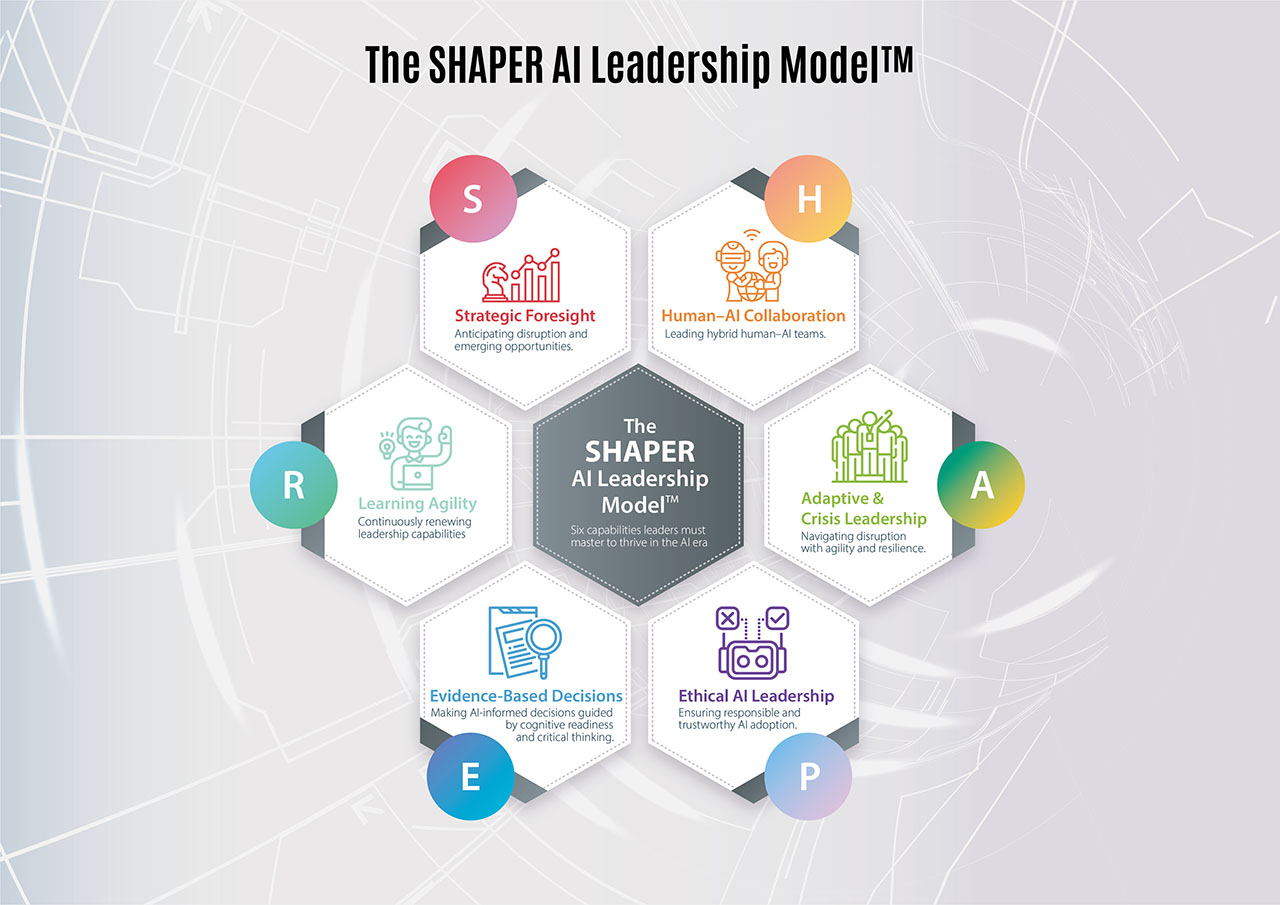
To address these challenges, the Disruptive Leadership Institute (DLI) developed the SHAPER Leadership Model™, a leadership capability framework designed specifically for the AI era.

The model identifies six essential leadership competencies required to successfully lead organizations through disruption and crisis.

AI-era leaders must SHAPE the future rather than react to it.

S — Strategic Foresight

Competency Overview

Strategic foresight is the ability to anticipate technological disruption, emerging risks, and future opportunities by systematically scanning the external environment and translating insights into forward-looking strategies.

In the AI era, leaders must move beyond traditional planning cycles and adopt a mindset of anticipatory leadership, identifying signals of change before they become industry-wide disruptions.

Strategic foresight enables organizations to position themselves ahead of technological shifts rather than respond reactively once disruption occurs.

Leadership Behaviors

Leaders demonstrating strong strategic foresight:

  • Continuously monitor technological trends, emerging AI capabilities, and evolving competitive dynamics
  • Analyze geopolitical, regulatory, and economic developments shaping technological adoption
  • Identify weak signals that may indicate emerging disruption or new market opportunities
  • Develop long-term scenarios that anticipate future industry transformations
  • Align organizational strategy with anticipated technological change
  • Encourage innovation and experimentation to explore future opportunities

Leadership Outcomes

Organizations led by strategically foresighted leaders:

  • Anticipate disruption earlier than competitors
  • Identify new AI-enabled business models and opportunities
  • Position themselves as industry innovators rather than followers
  • Maintain strategic resilience in turbulent environments

H — Human-AI Collaboration

Competency Overview

Human-AI collaboration refers to the ability to design and lead hybrid ecosystems in which human expertise and artificial intelligence work together to enhance decision-making, innovation, and organizational performance.

Rather than viewing AI as a replacement for human talent, effective leaders treat AI as an augmentation technology that amplifies human creativity, judgment, and problem-solving capability.

Successful AI-enabled organizations integrate machine intelligence into workflows while preserving the uniquely human capacities required for leadership.

Leadership Behaviors

Leaders who excel in human-AI collaboration:

  • Design workflows that integrate AI insights with human judgment
  • Promote AI literacy across leadership teams and the broader workforce
  • Encourage employees to leverage AI tools to enhance productivity and innovation
  • Establish new roles and operating models that enable human-AI synergy
  • Foster trust and transparency in AI-assisted decision processes
  • Ensure that human oversight remains central to critical organizational decisions

Leadership Outcomes

Organizations that effectively integrate human-AI collaboration:

  • Achieve greater productivity and innovation
  • Improve decision quality through augmented intelligence
  • Develop more agile and adaptive workforces
  • Unlock new capabilities that neither humans nor machines could achieve alone

A — Adaptive & Crisis Leadership

Competency Overview

Adaptive leadership refers to the ability to navigate uncertainty, respond to disruption, and lead organizations through rapidly changing environments.

In the AI era, leaders must operate within complex systems characterized by technological acceleration, regulatory uncertainty, and global economic volatility. Effective leaders must demonstrate resilience, flexibility, and the capacity to make decisions under conditions of incomplete information.

Adaptive leaders embrace experimentation, learn from failure, and recalibrate strategy as new information emerges.

Leadership Behaviors

Leaders with strong adaptive capabilities:

  • Demonstrate resilience in the face of disruption and uncertainty
  • Make timely decisions despite incomplete or evolving information
  • Encourage experimentation and rapid learning cycles
  • Adjust organizational strategies as technological landscapes evolve
  • Mobilize teams quickly during crises or disruptive events
  • Maintain organizational focus while navigating complexity

Leadership Outcomes

Organizations led by adaptive leaders:

  • Respond rapidly to technological disruption
  • Maintain operational resilience during crises
  • Build cultures that support experimentation and innovation
  • Sustain competitive advantage in dynamic environments

P — Principles of Ethical AI Leadership

Competency Overview

Ethical AI leadership focuses on ensuring that artificial intelligence is developed and deployed responsibly, transparently, and in alignment with societal values.

As AI systems increasingly influence business decisions, hiring processes, financial services, and public policy, leaders must ensure that ethical governance frameworks guide AI adoption.

Responsible AI leadership strengthens stakeholder trust and reduces reputational, legal, and regulatory risks.

Leadership Behaviors

Ethical AI leaders:

  • Establish governance frameworks for responsible AI development and deployment
  • Ensure transparency and accountability in AI-enabled decision systems
  • Monitor algorithms for bias and unintended consequences
  • Protect data privacy and uphold regulatory compliance standards
  • Engage stakeholders in discussions around ethical technology use
  • Foster organizational cultures grounded in integrity and trust

Leadership Outcomes

Organizations demonstrating ethical AI leadership:

  • Build trust with customers, employees, and regulators
  • Reduce risks associated with algorithmic bias or misuse of technology
  • Strengthen brand reputation and stakeholder confidence
  • Position themselves as responsible innovators in the AI ecosystem

E — Evidence-Based (Data-Driven) Decision Leadership

Competency Overview

Evidence-based decision leadership involves leveraging AI-generated insights and advanced analytics to inform strategic decision-making while maintaining strong cognitive readiness and critical thinking.

In an era of data abundance, leaders must develop the ability to interpret complex information, question algorithmic outputs, and balance analytical insights with strategic judgment.

Effective leaders recognize that AI provides powerful analytical tools, but leadership still requires human interpretation, ethical reasoning, and contextual understanding.

Leadership Behaviors

Evidence-based leaders:

  • Integrate AI-driven analytics into executive decision processes
  • Develop cognitive readiness to interpret complex data environments
  • Apply critical thinking to challenge assumptions embedded in algorithms
  • Balance data insights with strategic experience and judgment
  • Encourage evidence-based thinking across leadership teams
  • Use predictive analytics to guide strategic planning and resource allocation

Leadership Outcomes

Organizations that demonstrate evidence-based decision leadership:

  • Improve strategic decision quality
  • Reduce biases in leadership judgment
  • Enhance organizational agility through data-informed insights
  • Strengthen competitive advantage through advanced analytics

R — Renewal through Learning Agility

Competency Overview

Learning agility refers to the ability of leaders to continuously acquire new knowledge, adapt their thinking, and evolve leadership capabilities in response to technological transformation.

In the AI era, the pace of change is accelerating. Leaders who rely solely on past expertise risk becoming obsolete.

Learning-agile leaders cultivate intellectual curiosity, embrace continuous development, and foster cultures that prioritize learning and innovation.

Leadership Behaviors

Leaders who demonstrate strong learning agility:

  • Continuously update their knowledge of emerging technologies and industry trends
  • Seek new perspectives and challenge existing assumptions
  • Encourage lifelong learning within leadership teams
  • Support experimentation and knowledge sharing across the organization
  • Invest in leadership development focused on future capabilities
  • Remain open to new ideas, technologies, and operating models

Leadership Outcomes

Organizations led by learning-agile leaders:

  • Adapt more rapidly to technological change
  • Develop resilient leadership pipelines
  • Foster cultures of innovation and curiosity
  • Maintain long-term relevance in evolving industries

Integrating the SHAPER Leadership Competencies

The six SHAPER competencies are interconnected and mutually reinforcing.

  • Strategic foresight shapes long-term vision.
  • Human-AI collaboration enhances organizational capability.
  • Adaptive leadership enables resilience amid disruption.
  • Ethical leadership builds trust and legitimacy.
  • Evidence-based decision-making strengthens strategic insight.
  • Learning agility ensures continuous renewal.

Together, these competencies define the leadership capability required to thrive in the age of artificial intelligence.

SHAPER Leadership Imperative

The organizations that will dominate the next decade will not simply deploy artificial intelligence.

They will develop leaders capable of anticipating disruption, harnessing human and machine intelligence, governing technology responsibly, and continuously renewing leadership capability.

In other words, they will SHAPE the future rather than react to it.

“In the age of intelligent machines, leadership advantage belongs to those who shape disruption rather than chase it.”

— Prof Sattar Bawany
CEO, Disruptive Leadership Institute LLC
Author, Future-Ready Leadership Book Series