About Prophetic Leadership Institute (PLI)

The Prophetic Leadership Institute (PLI) is a specialist subsidiary of the Disruptive Leadership Institute (DLI), New York, dedicated to developing ethically grounded, future-ready leaders by blending classical prophetic principles with modern leadership practice. PLI delivers transformational, human-centered programs, both face-to-face and virtual, that adapt prophetic teachings and the Seerah (the life and leadership of the Prophet Muhammad ﷺ) to contemporary challenges faced by executives, boards, and public-sector leaders. These offerings include masterclasses, executive workshops, and bespoke coaching designed to translate spiritual-ethical insight into practical decision-making, stakeholder stewardship, and resilient organizational culture.

The icon “ﷺ” is an Arabic ligature that translates to “peace and blessings be upon him (PBIH)”. This specific honorific is used by Muslims exclusively when mentioning or writing the name of the Prophet Muhammad, as a sign of love, respect, and obedience to a divine command in the Qur’an.

PLI’s Mission, Vision and Values

Definition of Education in Islam

The revelation of the first surah of the Holy Qur’an delivered by Malaikat Jibril (archangel Gabriel) to the Prophet Muhammad (ﷺ) is concerning education. The significance, variety, and benefit of education were mentioned directly and indirectly in many surahs (chapters of the Qur’an).

The readers of the Qur’an are frequently requested to use their senses to learn, study and understand truly the meanings. They need to generate dynamically their mind, sight, aural, oral capabilities, and deeds to acquire the gist. These were practiced and manifested during the life of the beloved Prophet (ﷺ), the Companions and the early generation of Muslim scholars during the glorious era of Islamic Civilization. This is to show that Islam is very meticulous in this vital aspect of the development, progress, and accomplishment of human beings in the present world and akhirah.

The meaning of education in its totality in the context of Islam is fundamentally in the combination of the terms Tarbiyyah, Ta’lim and Ta’dib. Literally, Tarbiyyah means ‘educate’, Ta’lim means ‘knowledgeable’ and Ta’dib is derived from the word ‘adaba’ means ‘moral’. These terms comprehensively are concerning the multilateral relationship between human and their society; humans and the environment; society and environment; and Allah. These cross-sectional relations all together represent the scope of education in Islam of both ‘formal’ and ‘non-formal’, comprising the Fardhu Ain and Fardhu Kifayah.

This is a great versatility that the Qur’an and the Prophet (ﷺ) mention repeatedly, the paramount importance of education and supremacy. It is stated in the Qur’an, “Allah will elevate those of you who are faithful, and ˹raise˺ those gifted with knowledge in rank. And Allah is All-Aware of what you do.” (Qur’an Chapter Al-Mujadilah Verse 11).  In this verse, Allah grants high ranks to those who obtain knowledge, and if a human being wants to rise, he should attain knowledge. Intuitively, the Prophet (ﷺ) has said that those who walk on the path seeking knowledge, Allah will thereby make easy to them the path of paradise (Hadith narrated by Tirmidhi). It had been proven in history that the Companions of the Prophet Muhammad (ﷺ), were truthful, honest, sincere, generous, brave, and willing to sacrifice their lives for Allah’s cause, jihad fisabilillah. They love Allah and His Messenger much more than they love themselves.

Prophetic Leadership based Islamic Education

The aims and objectives of Prophetic Leadership-based Islamic education, basically are: to provide the teachings of the Holy Quran as the primary source of education; to provide experiences that are based on fundamentals of Islam as embodied in the Holy Quran and Sunnah which cannot be changed; to provide experiences in the form of knowledge and skills with clear understanding that these experiences are likely to be changed in light of changes in society; to develop understanding that knowledge without the basis in faith and religion is in complete education; to develop commitment towards the basic values which have been prescribed; to develop a sense of accountability towards the Almighty creator so that man can perform and succeed in life; to encourage international brotherhood irrespective of differences in races and origins; to foster great consciousness of the Divine Presence in the universe; to bring man nearer to an understanding of God and of the relation in which Man stands to his Creator; to develop piety and faith among the followers; to produce man who has faith as well as knowledge in spiritual development; and, to develop high quality of a good man who is universally accepted and has faith in righteous religion.

To date, little empirical research has been conducted on prophetic leadership with an integrative focus that is multilevel, multi-component and interdisciplinary, while recognizing that leadership is a complex function of both the organizational leaders and the followers who perform tasks, all of which subsequently leads to decision making qualities. Indeed, the current leadership model focuses on leadership behavior and the ability to gain followers mutuality, to achieve decision-making quality involving the integration of leadership and social network theories. Given the apparent mutable palette of contemporary leadership theory, this emergent construct of the leadership paradigm can expand the poles of the leadership continuum and contribute to a richer and deeper understanding of the relationships and responsibilities of leaders and followers as they relate to decision-making qualities in an organizational context. This new construct, which is termed prophetic leadership, explores the life experiences of the Prophet Muhammad (ﷺ).

About the Prophetic Leadership Masterclass Series Program

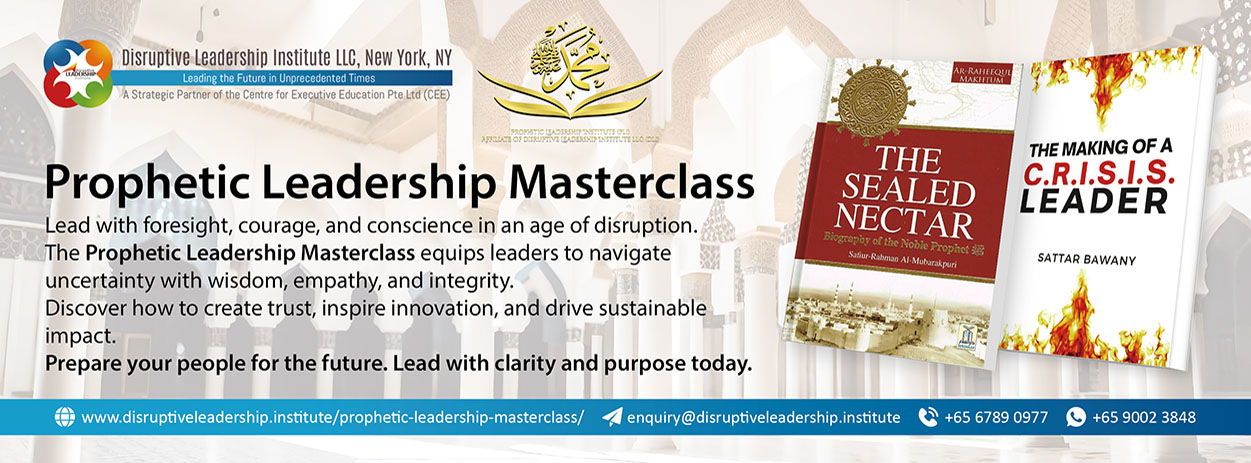
Management as a discipline has evolved for more than a century, shaped by diverse organisational theories and leadership philosophies. The Prophetic Leadership Masterclass Program builds on this rich heritage while grounding its core principles in the teachings of Islam and the Seerah,  the life and leadership legacy of Prophet Muhammad ﷺ, as well as the exemplary guidance of the righteous Caliphs. Each module is carefully designed to translate these timeless prophetic principles into relevant and actionable leadership practices for today’s organisational landscape.

The program is delivered by two Master Facilitators:

A subject matter expert in Islamic Studies (Al-Qur’an and Al-Sunnah / Revealed Knowledge) who provides deep scholarly insight into prophetic guidance and Islamic ethical frameworks.

A contemporary leadership and business expert who connects these spiritual foundations to modern leadership demands, organisational realities, and global best practices.

In addition to exploring leadership lessons from the life of Prophet Muhammad ﷺ, the Masterclass Series demonstrates how these principles are applied in today’s context by successful leaders across high-performing organisations worldwide. This ensures participants not only learn the prophetic ideals but also see how they translate into practical, high-impact leadership behaviours relevant to contemporary challenges.

A key segment of the program is facilitated by Prof Sattar Bawany, our award-winning CEO and C-Suite Master Executive Coach. Prof Bawany brings over 30 years of global business experience, including full P&L leadership, extensive consulting engagements, and executive coaching of Boards, CEOs, and senior leaders around the world. He is the author of the acclaimed “Future-Ready Leadership” book series and has published widely on contemporary leadership and organizational transformation.

The curriculum is customised to align with the client organisation’s corporate strategy and leadership competency framework, ensuring direct relevance and measurable impact.

The overarching goal of the Masterclass Program is to equip leaders with the practical knowledge, skills, tools, and spiritual grounding needed to become holistic, values-driven, transformational, and critical-thinking leaders. Participants will be empowered to guide their teams with confidence, embody their organisation’s mission and values, and create sustained, meaningful impact across the organisation.


Research-based Content Development

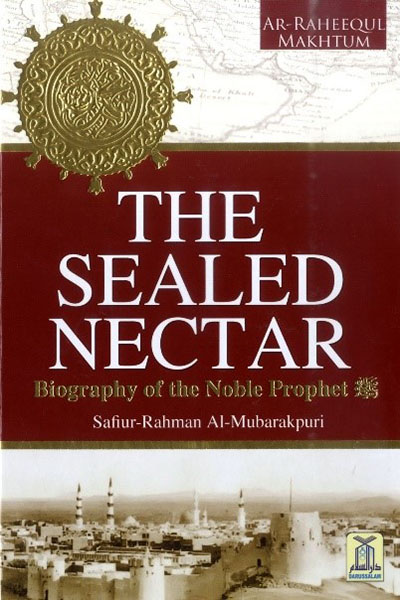
The full 3-day Masterclass program will draw primarily from “The Sealed Nectar: Biography of the Noble Prophet ﷺ”  (Ar-Raheeq Al-Makhtum), the authoritative and award-winning Seerah text authored by renowned contemporary scholar Sheikh Safiur Rahman Mubarakpuri. This seminal work provides a comprehensive, authentic account of the life and leadership of Prophet Muhammad, forming the foundational reference for the program’s teachings and insights.

A complete authoritative book on the life of Prophet Muhammad (ﷺ) by Sheikh Safi-ur-Rahman al-Mubarkpuri. It was honored by the World Muslim League as a first-prize winner book.

Whoever wants to know the whole lifestyle of the Prophet in detail must read this book. Muhammad (ﷺ) is the Messenger of Allah, and those who are with him, are severe against the disbelievers and merciful among themselves. You see them bowing and falling down prostrate (in prayer), seeking bounty from Allah and (His) Good Pleasure. The mark of them (i.e., of their Faith) is on their faces (foreheads) from the traces of prostration (during prayers). This is their description of the Taurah (Torah). But their description in the Injeel (Gospel) is like a (sown) seed which sends forth its shoot, then makes it strong, and becomes thick and it stands straight on its stem, delighting the sown seeders, that He may enrage the disbelievers with them. Allah has promised those among them who believe and do righteous good deeds, forgiveness, and a mighty reward (Paradise). (Reference: Qur’an Chapter 48 (Al-Fath) Verse 29)

“The Prophet (ﷺ) said, “The example of guidance and knowledge with which Allah has sent me is like abundant rain falling on the earth, some of which was fertile soil that absorbed rain water and brought forth vegetation and grass in abundance. (And) another portion of it was hard and held the rainwater and Allah benefited the people with it and they utilized it for drinking, making their animals drink from it and for irrigation of the land for cultivation. (And) a portion of it was barren which could neither hold the water nor bring forth vegetation (then that land gave no benefits). The first is the example of the person who comprehends Allah’s religion and gets benefit (from the knowledge) which Allah has revealed through me (the Prophets and learns and then teaches others. The last example is that of a person who does not care for it and does not take Allah’s guidance revealed through me (He is like that barren land.)” (Reference: Hadith on Knowledge, Sahih al-Bukhari 79)

In Islam, leadership is a process of impacting, influencing, and inspiring followers, of their own free will, to fulfill a clear as well as a shared vision. The ultimate objective of Islamic leadership is to act according to Islam which is to be Syariah compliant.

From a contemporary perspective, leadership is a prime function of management; every organization needs a leadership model which may meet the values of work floor culture. A leadership model which is aligned with the organizational values can resolve the dilemmas and can motivate the rest of the functions of the organization (Bawany 2019).

Leadership theories have been evolving in different epochs of time. Servant leadership appears as a fresh model which is people-centered and most effective with the contemporary designs of the organization. In today’s leadership crises within organizations (including businesses and government institutions) across the globe, the underlying factor is the inability to identify, assess, select and develop leaders who can manage the near-insurmountable challenges operating in a highly disruptive and ever-changing business environment (Bawany 2020).

Research has shown one of the main reasons good employees leave a workplace is their dissatisfaction with leadership. So what can you do to be that inspirational leader we all want and deserve? We’ve compiled a list of positive traits that employees love to see in their leadership.  People want leaders who listen to them and empower them rather than those who practice power over them. Such a responsibility would create a sense of anxiety for any leader, especially in trying to adopt an appropriate leadership style to produce the required change (Bawany 2023).

Prophetic leadership in crisis management is a leadership approach rooted in ethical conduct, a strong moral compass, and prioritizing community well-being. It emphasizes leading by example with wisdom and compassion, especially during challenges, inspired by the practices of figures like Prophet Muhammad (PBUH). This style focuses on guiding people through crises with a commitment to the greater good (Bawany 2025).

Participants will also be able to draw from case studies on contemporary transformational leadership practices which are based on comparative studies to that of the prophetic leadership traits and approaches. These contemporary leadership practices are drawn from extensive research including the series of books published on Transformational, Disruptive, and Crisis Leadership.

Course Description

The program is designed to equip leaders with the knowledge, skills, values, and spiritual insight needed to drive meaningful, positive change within their teams and organisations, regardless of their functional roles or domains. Participants will strengthen their capacity for change-making and leadership excellence by developing self-leadership, enhancing team effectiveness, and fostering organisational performance rooted in purpose and integrity.

Throughout the program, participants will explore foundational principles of servant leadership, coaching, and contemporary leadership thinking, while gaining fresh perspectives on how leadership is both socially constructed and inherently ethical. These insights will be examined through the lens of prophetic leadership — emphasising compassion, justice, humility, and moral courage.

The Master Facilitators will guide participants through essential theories and practical competencies that integrate Islamic values with timeless lessons from the Qur’an and Sunnah. These will be combined with core leadership skills to provide a holistic, actionable framework for leading with character, clarity, and impact.

Learning Outcomes

  1. Develop a deep appreciation of the Islamic perspective on exemplary leadership and its relevance to modern organisational contexts.
  2. Strengthen understanding of the historical foundations, concepts, challenges, and leadership dilemmas faced throughout Islamic history.
  3. Critically explore Muslim leadership identity with emphasis on its connection to spirituality, socio-economic realities, social justice, and the responsibility of leading teams and organisations with integrity.
  4. Gain insight into key theoretical approaches to organisational leadership and communication, enabling participants to lead more effectively and exert positive, values-based influence.
  5. Engage with experienced thought leaders to learn practical strategies for navigating contemporary leadership challenges while applying Islamic principles rooted in the Qur’an and Sunnah of the Prophet (ﷺ).

Draw inspiration from the devotion, character, and exemplary leadership of Prophet Muhammad (ﷺ), applying these lessons to both personal growth and professional leadership practice.

Course Duration

3 Full Days (In-Class/In-Person) or 6 x 0.5 Days (Virtual) Workshop depending on the client’s specific requirements and the no. of competencies or values to be covered in the program.

Course Preparation

To maximise the learning experience and ensure participants are fully prepared for the workshop, a set of curated pre-readings will be provided in advance. These materials are carefully selected to introduce key themes, concepts, and frameworks that will be explored during the program. Participants are encouraged to review these readings before the session to build a strong foundational understanding and to enhance the depth of discussion and reflection during the workshop.

The pre-readings will include:

  1. Essential texts and excerpts related to the workshop theme, including foundational Islamic leadership principles, relevant Seerah highlights, and contemporary leadership insights.
  2. Articles and thought pieces that contextualise prophetic leadership within today’s organisational and societal challenges.
  3. Short multimedia resources, where applicable, to provide additional perspectives and stimulate critical thinking.

Participants are advised to allocate adequate time for thoughtful reading, personal reflection, and noting key questions or insights. This preparation will support more meaningful engagement, enrich group discussions, and enable participants to connect the workshop content to their own leadership experiences and organisational realities.

Course Methodology

The program’s methodology is grounded in experiential learning, meaningful dialogue, and reflective practice. Drawing from our experience, participants gain the greatest value when they learn directly from seasoned senior leaders whom they respect and trust. Inviting the organisation’s Chairman, CEO, or other key executives to open the workshop and engage in dialogue throughout the program significantly enhances its impact. Their presence helps reinforce the organisation’s commitment to leadership excellence and provides participants with authentic insights into the leadership journey, lived values, and real-world challenges.

These senior leaders will also play an important role in encouraging participants to share their own reflections on the organisation’s core values and how they can be embodied more meaningfully in day-to-day work.

The facilitators will utilise a critical-thinking-driven–driven approach, guiding participants through structured inquiry, reflective questioning, and scenario-based discussions. Throughout the workshop, participants will be challenged to deeply examine key prophetic leadership principles and reflect on how these timeless lessons can inform their responses to contemporary workplace challenges.

Through a blend of facilitated dialogue, case studies, self-assessment exercises, and group learning activities, participants will learn to analyse problems holistically and make thoughtful, values-aligned decisions. The methodology emphasises integrating contemporary leadership frameworks with prophetic leadership wisdom, enabling participants to internalise organisational values and contribute effectively to achieving the organisation’s mission and strategic objectives.

Overall, this approach ensures that participants don’t merely learn leadership theories — they experience them, apply them, and translate them into actionable behaviours that elevate both personal and organisational performance.

Sample Module

The basis of this program on Prophetic Leadership is the Holy Quran and the Sacred Sunnah.

Allah the Exalted says:

لَّقَدْ كَانَ لَكُمْ فِى رَسُولِ ٱللَّهِ أُسْوَةٌ حَسَنَةٌۭ لِّمَن كَانَ يَرْجُوا۟ ٱللَّهَ وَٱلْيَوْمَ ٱلْءَاخِرَ وَذَكَرَ ٱللَّهَ كَثِيرًۭا

Indeed, in the Messenger of Allah (Muhammad (ﷺ)) you have a good example to follow for him who hopes in (the Meeting with) Allah and the Last Day and remembers Allah much.

Reference: Qur’an Surah Al-Ahzab Verse 21.

The Definition of Sunnah according to the Scholars of Hadeeth:

كل ما أثر عن النبي ﷺ من قول، أو فعل، أو تقرير، أو صفة خَلقية أو خُلقية، أو سيرة سواء أكان ذلك قبل البعثة كتحنثه في غار حراء، أم بعدها.

Everything which is narrated concerning the Prophetﷺ (ﷺ), whether it is his saying, action, or silent approval as well as his attributes concerning both characteristics and behavior, or his life story, before his Prophethood and after it (whole life).

For example, the actual title of Sahih al-Bukhari:

“الجامع المسند الصحيح المختصر من أُمور رسول الله و سننه وأيامه”

  1. The Compilation of concise authentic authorized descriptions of the Messenger of Allah, his traditions, and his life story.
  2. Hence, the core values of this “Prophetic Leadership” are derived from the Holy Quran, the Sacred Sunnah, and the biography of our beloved Prophet Muhammadﷺ (ﷺ) based solely on reliable narrations.
  3. Yet, all the examples cited in this program, are about the Prophet’s personal decisions and initiatives not exactly or directly from Allah’s Divine Inspiration and Instruction (al-Wahyu) to him, which he used to discuss with the Companions in making crucial decisions.

Intrinsic Main Attributes of All Prophets:

The main attributes or traits which all Prophets must possess are:

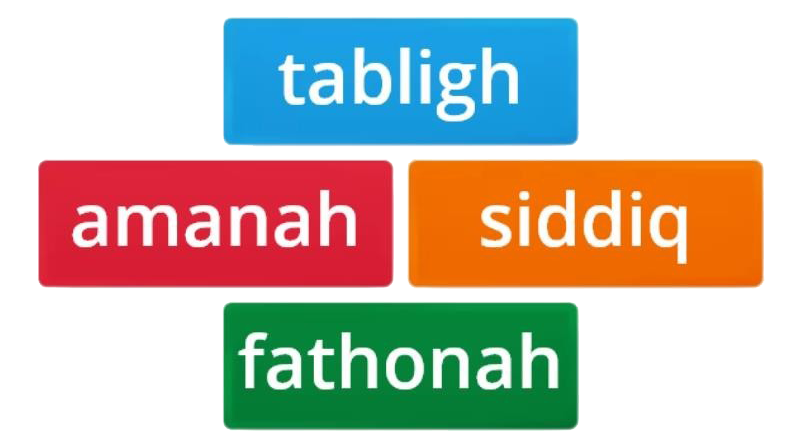
 – al-Ṣidqu (الصدق – Truthfulness),

– al-Amānah (الأمانة – Trustworthiness) and

– al-Fiṭanah/al-Faṭānah (الفَطانة/الفِطَنة – eloquence/shrewdness and foresight)

The above are the 3 attributes or traits that every Prophet (Nabiy) should possess according to most scholars.

As for al-Tablīgh (التبليغ – conveyance), it is regarded as the 4th trait that is specifically for a Rasūl (Messenger) to have, according to most of the scholars of ‘Aqā’id (Matters of Belief).

However, the basis for this is much related to their definition or classification of a Nabi and that of a Rasul and the difference between these two, which is a matter of dispute among scholars.

In conclusion, according to most scholars, almost consensus, all Prophets and Messengers should bear these 4 qualities as their most essential attributes to fulfill their role as Allah’s Apostles and convey Allah’s message. There is no clear explicit ‘daleel’ or textual proof for the specification of these traits and some scholars refrained from specifying these 4 qualities they mentioned among others, sanity, piety and righteousness, clarity in speech, good-looking and no physical imperfection, and all other qualities mentioned in the Qur’an and the Sunnah.

Recommended Texts/Resource Readings

  1. Safi-ur-Rahman al-Mubarakpuri (1996). Ar-Raheeq al-Makhtûm (The Sealed Nectar): Biography of the Noble Prophet. 1st edition. Riyadh: Maktaba Dar-us-Salam Publishers, Riyadh, Saudi Arabia.
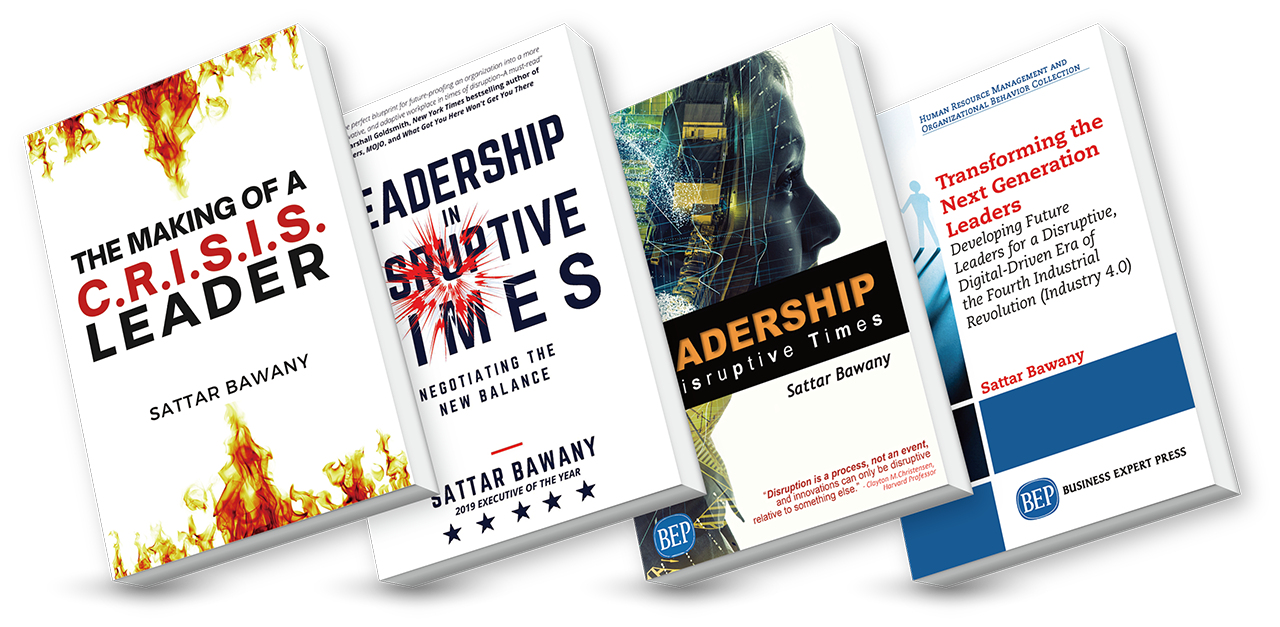
  2. Sattar Bawany (2025). The Making of a CR.I.S.I.S. Leader. Business Expert Press (BEP) Inc., New York, NY.
  3. Sattar Bawany (2023). Leadership in Disruptive Times: Negotiating the New Balance. Business Expert Press (BEP) Inc., New York, NY.
  4. Sattar Bawany (2019). Transforming the Next Generation Leaders: Developing Future Leaders for a Disruptive, Digital-Driven Era of the Fourth Industrial Revolution (Industry 4.0).  Business Expert Press (BEP) Inc., New York, NY.
  5. John Adair (2010). The Leadership of Muhammad. Kogan Page, London, UK.
  6. Abu al-Fiḍā ‘Imād Ad-Din Ismā‘īl ibn ‘Umar ibn Kathīr al-Qurashī Al-Damishqī (1998). The Life of the Prophet Muhammad: Al-Sîrah alNabawiyya. Translated by Trevor Le Gassick. Reviewed by Ahmad Fareed and Muneer Fareed.: Garnet Publishing Limited, Reading, UK.
  7. Abū Ghuddah, ʻAbd al-Fattāḥ (2003). Prophet Muhammad the Teacher and His Teaching Methodologies. Zam Zam Publishers, Karachi, Pakistan.
  8. Muhammad Ibn Ishâq, (1955). Ibn Ishaq’s The Life of Muhammad. Translated by Alfred Guillaume. Oxford University Press, 1955. London, UK.
  9. Muhammad Sa‘id Ramadan al-Buti (1988). Jurisprudence in Muhammad’s Biography: Scientific and Systematic Studies of Lessons, Principles, and Constitution. Translated and abridged by Ali Rustum. 1st ed. Dar al-Ma’arifah, Damascus, Syria.
  10. Muhammad al-Ghazali (2022). Fiqh-us-Seerah: Understanding the Life of Prophet Muhammad. 2nd ed. International Islamic Publishing House (IIPH). Riyadh, Saudi Arabia.

Conclusion: Supplication (Dua) on Seeking Knowledge

In Surah Al-Baqarah, verse no 32, Allah says in the Quran,

They said,

“Exalted are You; we have no knowledge except what You have taught us. Indeed, it is You who is the Knowing, the Wise.”

Reference: Qur’an Surah Al-Baqarah Verse 32.

‘O Allah, I seek refuge in you from the kind of knowledge which does not give benefit, from the heart in which there is no fear, from the soul which does not become satisfied and Dua which is not accepted.’ Aamiin Aamiin Aamiin Ya Rabbal Al-Aamiin.

Contact Details

For a detailed Course Outline and/or a no-obligation preliminary discussion on this program, please submit your online inquiry here. Alternatively, email us at [email protected].